Commercial Grade Home Networks in West Vancouver and Whistler
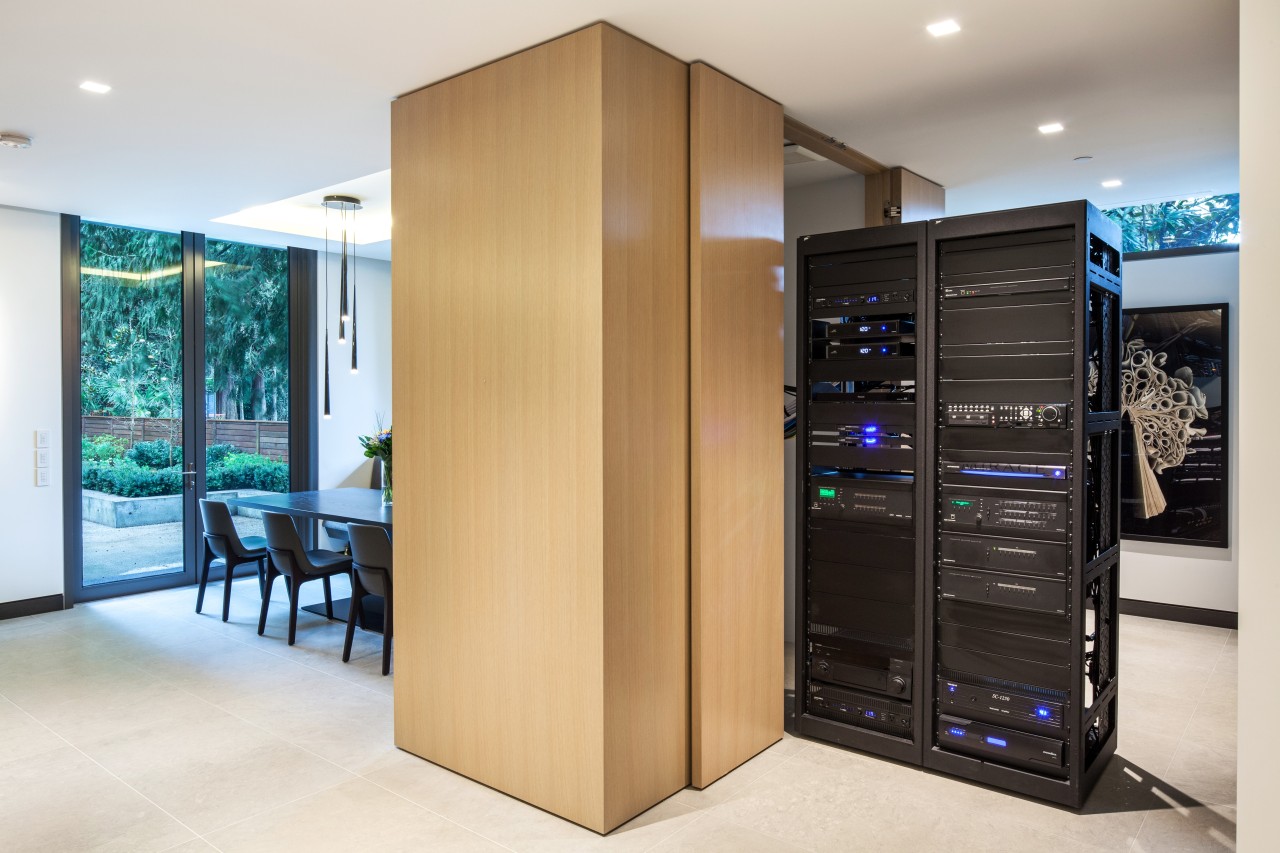
Commercial Grade Home Network Design in West Vancouver and Whistler
If you are building or renovating a luxury home in West Vancouver or Whistler, chances are you want your technology to feel effortless. Work calls, streaming, whole home audio, cameras, and control systems all rely on the same thing: a network that simply works, all the time, without drama.
At the same time, you do not want your home to look like a server room. You want commercial reliability and uptime, but you do not want commercial looking hardware on your walls or ceilings. This is where a resimercial approach makes sense, applying professional grade networking practices in a way that respects residential architecture and interior design.
SEE ALSO: High Performance Wi-Fi and Networking for Smart Homes
SEE ALSO: How the Graytek Design and Build Process Works
SEE ALSO: Smart Home Automation Foundations
What “resimercial” should mean in a high performance home
Commercial networks are designed for uptime, stability, and predictable performance. Hundreds or thousands of devices share the same infrastructure, and if the network fails, the business stops. In that world, you design first, then build, and you treat the network as critical infrastructure, not a consumer gadget upgrade.
Your home in West Vancouver or Whistler may not have hundreds of staff, but it does have dozens or even hundreds of IP devices. Audio, video, lighting, control processors, cameras, access control, work laptops, tablets, TVs, and guests all expect fast, stable connectivity. A professional grade residential network treats this exactly the way Graytek treats other foundations such as structured wiring, racks, and power: it is infrastructure that needs to support the home for 10 to 20 years, not a box from the electronics store that gets replaced every couple of years.
The core pain point: commercial reliability without commercial looking hardware
Many of our clients say the same thing in early discovery meetings. They want the stability, performance, and support you expect from a commercial deployment, but they do not want to see it. No plastic routers on shelves, no visible cable clutter, and no office style access points dominating the ceiling in a feature room.
For Graytek, the answer is not to compromise reliability for aesthetics, or aesthetics for reliability. The answer is a design first process and strong foundations. Network, wiring, and rack design happens at the same time as architectural, electrical, and interior design. That is how you get commercial level performance that quietly disappears into a finished residence.
Where commercial networking practices make sense at home
Not every commercial feature belongs in a residence, but several core practices are essential for any high performance home in West Vancouver or Whistler. These are the areas where “resimercial” pays off.
Designing coverage properly, not guessing on site
Large custom homes are complex environments for Wi-Fi. Concrete, steel, window coatings, radiant floors, vaulted ceilings, and outdoor living spaces all impact signal. A single router or retail mesh kit is not built for this type of project, and trial and error placement on site wastes time and rarely delivers the stability you expect.
Commercial thinking means designing coverage in advance. Graytek treats the network as a system to be engineered, using structured cabling, properly placed access points, and central configuration. The result is even coverage across the entire property, including outdoor areas, without dead spots or random performance gaps
Using infrastructure grade equipment instead of consumer kits
A modern smart home network carries far more than web browsing traffic. It moves 4K video, multiroom audio, control signals, camera streams, intercom, and more, often at the same time. Consumer routers, mesh systems, and plug in extenders are not designed to manage this kind of load or prioritise critical traffic. That is why Graytek standardises on professional grade, cloud managed networking platforms for residential projects
This type of equipment is not chosen for its flashing lights or industrial styling. It is chosen because it can be centrally managed, segmented, documented, and supported for many years, while still being hidden in dedicated rack spaces and technical areas away from finished rooms
Segmentation, security, and stability that fit real life
In a commercial space, networks are often segmented so that different types of devices and traffic do not interfere with one another. The same idea is valuable at home, especially in large residences where you have smart home equipment, cameras, staff devices, work laptops, and guest devices all sharing the same infrastructure.
Graytek designs networks with isolation and Quality of Service in mind, so that critical subsystems such as control, cameras, and access control stay responsive even when someone starts a large download or cloud backup. This is about more than fast Wi-Fi. It is about predictable performance, security, and long term serviceability
Structured wiring and racks as permanent foundations
The most stable wireless network is built on a solid wired backbone. In a new build or major renovation, this is your only opportunity to get the physical infrastructure right before the walls close. Graytek treats structured wiring and racks as non negotiable foundations, not as optional add ons
That means properly routed Cat6A and fibre runs, labelled patch panels, documented pathways, and equipment mounted in engineered racks that are ventilated, serviceable, and built for long term growth. This is very similar to how a commercial environment approaches backbone infrastructure, but tailored to the layout, scale, and aesthetic priorities of a private residence
Proactive monitoring and remote support
In commercial settings, networks are monitored so that issues can be caught and resolved quickly. For high performance residential projects, the same mindset is incredibly valuable. Cloud managed networking allows Graytek to see the health of the system, respond faster, and often resolve issues without an onsite visit, which is especially important for homes in Whistler and the Sea to Sky Corridor
This is a key part of the “it just works” experience. When something changes on the network, there is a plan, a toolset, and a support pathway ready to deal with it, instead of starting from scratch every time a device drops offline.
Where commercial practices do not belong in a luxury residence
Resimercial does not mean copying a corporate server room into your mechanical space. It means being selective and thoughtful about which practices serve your lifestyle, and which would only add cost or visual clutter.
Avoiding unnecessary complexity
Some enterprise features are designed for multiple buildings, hundreds of staff, or highly specialised security environments. In a private home, that level of complexity can make the system harder to understand and less enjoyable to live with, without delivering any meaningful day to day benefit.
Graytek focuses on the elements that improve reliability, supportability, and security, then leaves the rest. The goal is not to turn your home into a data centre. The goal is a calm, predictable experience where technology quietly does its job in the background.
Keeping hardware out of sight in finished spaces
Luxury homes in West Vancouver and Whistler are defined by materials, views, and clean lines. Commercial looking technology scattered throughout the home fights that intent. Graytek’s design first approach keeps visible hardware to a minimum, centralises equipment in proper racks, and coordinates device locations with the architectural and interior design teams
This includes planning for discreet access points, avoiding exposed cabling, and ensuring that any necessary visible devices are aligned with the overall design language of the project. You get commercial reliability without commercial visual impact.
Graytek’s design first, foundations led process
The most important difference between a consumer style network and a professional grade residential network is not the hardware. It is the process. Graytek uses a structured project lifecycle across all systems, including networking: Discovery, Design, Execution, and Service
Discovery: understanding how you really use the home
Before we specify equipment, we look at how you plan to live in the home. Do you work from home regularly. How many people stream at the same time. Are there outbuildings, coach houses, or detached garages. Do you have staff or vendors who need managed access. The answers shape everything from cabling to access point layout to security policies
Design: treating the network as infrastructure
From there, we design the network to the same standard as the rest of the smart home architecture. That includes structured wiring designs, rack layouts, network addressing schemes, and documentation long before we set foot on site
In practical terms, this means that the network is not a separate afterthought. It is coordinated with framing, electrical, mechanical, and interior design, so pathways, backboxes, ventilation, and service clearances are all accounted for from the start
Execution: clean, serviceable installation
During installation, Graytek builds and tests racks in house, cable manages and labels every connection, and commissions the network as part of a larger integrated system, not as a separate piece of hardware
This is where the foundations mindset pays off. A well built rack and backbone make it easier to support the home for the next decade, adapt to new services, and keep all the connected systems working together as technology evolves
Service: long term performance and reliability
After handover, the same infrastructure and documentation make it possible to monitor, maintain, and upgrade the system with minimal disruption. Firmware updates, configuration changes, and troubleshooting can often be handled remotely, and on site visits are more focused and efficient because the system is known and documented
What builders and design teams should know
For builders, architects, and interior designers working on new builds and major renovations, the key takeaway is timing. Resimercial networking and smart home foundations only deliver their full value when Graytek is involved early, ideally before framing is complete. Network and system infrastructure touches framing, millwork, electrical, HVAC, and lighting plans, so it needs a seat at the design table from the start
When that happens, we can plan dedicated rack locations, risers, conduit, and cable pathways, reserve ceiling locations for discreet access points, and coordinate with trades to avoid conflicts later. The outcome is a cleaner build, fewer surprises, and a home where the technology feels fully integrated rather than bolted on at the end
The takeaway: commercial reliability, residential calm
Resimercial networking is not about turning your home into a commercial space. It is about borrowing the best of that world design, documentation, segmentation, and proactive support and applying it to a luxury residential environment where aesthetics, comfort, and long term serviceability all matter just as much as raw performance
If you want a home in West Vancouver or Whistler where everything just works, without visible technology clutter, the path starts with a design conversation and a solid plan for your network foundations.
Next step: book a performance and reliability consult
Book a consult with Graytek to develop a performance and reliability plan for your new build or major renovation in West Vancouver or Whistler. We will review your plans, understand how you want to use the home, and map a practical resimercial strategy that delivers commercial grade stability with residential level calm.
To get started, contact the Graytek team at
When you subscribe to the blog, we will send you an e-mail when there are new updates on the site so you wouldn't miss them.


